Rez and The Fountain
It was my 26th Birthday yesterday, and in order to make myself feel old and realise how quickly life seems to be passing me by, I started thinking about those moments in my life that you never forget. It's been over four years since the moment I first played a demo of
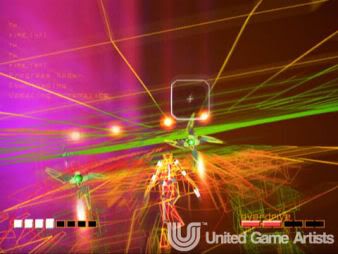
Rez on the PS2. Having ditched console gaming in favour of the downright-better-in-every-way PC, I was surprised to be playing a game so elegant, so intelligent, so esoteric and just so damn great. It was so attuned to the way I thought games should be that I immediately went out and bought myself a Dreamcast and a copy of the game.
I spent months playing it, playing levels over and over again, just admiring the sheer beauty and breathtaking purity of the game - it wasn't trying to be cinema or a comic book - it just was a game. I wrote pages and pages of notes for my dissertation on the game, and did a lot of research into
Kandinsky and
synaesthesia, as well as the nature of religion in games. Swept away in such an incredible deluge of information that I couldn't see any way to feasibly construct a meaningful 10,000 word essay on the subject, I chose to write about
Half-Life instead.
The concept in
Rez that I found most fascinating and frustrating was the nature of the balance between science and religion in the game. Set within a computer whose rampant AI has reached a critical point, the player character must destroy "viruses" and set free the core which has evolved into a beautiful woman. Or something. It's a bit confusing, and the game plays like sitting in a shopping trolley being hurtled down a darkened alley whilst someone throws radioactive Transformers at you. Anyway, what's fascinating is that within this setting the AI has its own notions of religion (in particular Buddhism), as witnessed in the imagery of the levels - huge temples and meditating avatars. It struck me that thematically it had much in common with Darren Aronofsky's film
pi, in which a scientist uncovers a pattern of numbers which seemingly hold the key to both science and religion. It doesn't say science and religion are the same, merely that there are similarities and neither can answer the really big questions we have about life.
Which brings me on to Aronofsky's latest film,
The Fountain. A love story set over a period of a thousand years, the film deals with protagonist Tom Verde's immortality after drinking the sap of the Tree of Life. Watching
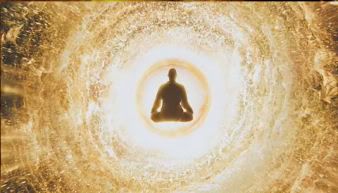
the trailer, the visual similarites of the "future" third of the movie to Rez are uncanny - both feature a meditating guy in a ball floating through a futuristic environment. I often wondered if, or how, one would be able to project
Rez's synaesthesia on the big screen, and hopefully this is it. I hope that when the film is released in March 2007, I get another one of those moments, this time sitting in a cinema.
Labels: Feature
Finally got round to pdfing and uploading my dissertation, take a look if you're in to that kind of thing. It's not complete, and if you're finding it boring just skip to the last chapter which is probably the best one.
Labels: Feature
Overlong waffily post of the month...
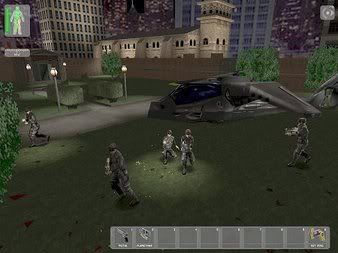
I just think about Deus Ex all the time now. Whenever I'm doing something, like making food or something, I think to myself "this is a bit like Deus Ex", or "this is nothing like Deus Ex." My new flat has a keycode-operated front door, and every time I use it I think I could use a multi-tool, but as I know the code I won't.
The thing about Deus Ex is how absurdly brilliant the level design is. Real-world locations work like real-world locations, and although there are physical barriers around the levels you truly get an impression of being able to go wherever you like. Invisible War is a brilliant catastrophe because it missed this essential element and divided the levels up too much.
I've played Deus Ex from start to finish about six times now. It's like a great album, one you can keep going back to because there's always something you've forgotten about it.
The other astonishing thing is, when you've played a game that much, any game, it becomes like music in that it gets stuck in your head. Just like you can randomly wake up with some annoying song in through your head that won't leave for the rest of the day, the same thing can happen with games. I frequently find myself thinking of a certain part of a certain level, and then visualising what lies around that next corner, or the nuances of the architecture. It's like when you remember the verse of a song and then automatically go on to remembering the chorus.
Yet again, I'm realising games are nothing like cinema. You don't get scenes from films stuck in your head, and if you do it's usually in the form of some scarcely-remembered dialogue or a chunk of the score. I personally never ever remember the sets or locations from films, because the focus is usually both literally and figuratively on character. But games allow interaction with space, and rely on your ability to cognicise and recognise spaces.
Music occupies a space between maths and art. It's about formulas, about understanding the often highly complex relationships between certain frequencies. And music is about giving us this maths in a way that's easy to understand. And games are very similar, the difference being they let us look at maths rather than hear it.
Labels: Feature
How do you convince someone you love that games are a good thing?
On April 1st I'm going to move in with my beautiful, intelligent girlfriend, who hates games with a passion. It's not much that she hates the games themselves, it's more the way they are such a major part of my life - I'm trying pretty hard to get into games journalism and I wrote my dissertation on
Half-Life.
But the element she has biggest issue with - and I see her point - is that I basically spend my whole day at work staring at a screen, and then I come home and relax by staring at a rather similar screen. I could be out cutting down trees to build a hut and skin a badger and eat it raw. Well, I could be out mountain biking or surfing or indulging in some other rugged sport. I made the point that it's no worse, and probably better than her watching television, but she correctly pointed out that she doesn't watch much anyway.
So after one reasonably big discussion about the nature of games, I came up with the idea of contacting a couple of respected games journalists to see what they thought, and putting the collected musings in this post. Those contacted were
Jim Rossignol and
Kieron Gillen, and I asked for their opinions and experiences of games and partners.
Jim was the first to respond with: 'I wish I knew the answer. My usual excuse is "well it pays the bills".' Which is great if you've got a job in the industry, but I don't.
Kieron, on the other hand, gave a far more comprehensive and reasoned argument (no offence Jim), explaining that there's a certain tendancy amongst partners in this situation to think of the computer "as the Other Woman;" that is, something you love and your partner doesn't understand why. And whilst this is kind of true, I do love my girlfriend more than games, and I'm always going to have time for her.
Kieron also suggests that I try and get my girlfriend in to games by playing something like singstar or dancemat games. This certainly does sound like an interesting option, but I'm pretty sure my girlfriend wouldn't want yet another console in the house on top of my NES and Dreamcast.
Kieron's best comment, however, was "all you can do is say that you think games are good, and that she really should respect that - and that, in turn, you'll try and give her all the time you want." This is cool, and I totally agree.
So, after a further conversation with my girlfriend, we came to a compromise - knowing how much I love games and want to get into games journalism, we decided that there will be no games in the house until I get a job writing about them. I don't mind missing out on games for a while, I enjoy writing about games almost as much as I enjoy playing them, and this will definitely give me a big push to actually get off my arse and start actually pursuing a career. But this could also mean that I never get to play another game for the rest of my life.
I'd better get writing...
Labels: Feature

